Skip to content
Sıfırıncı Dakika
Latest

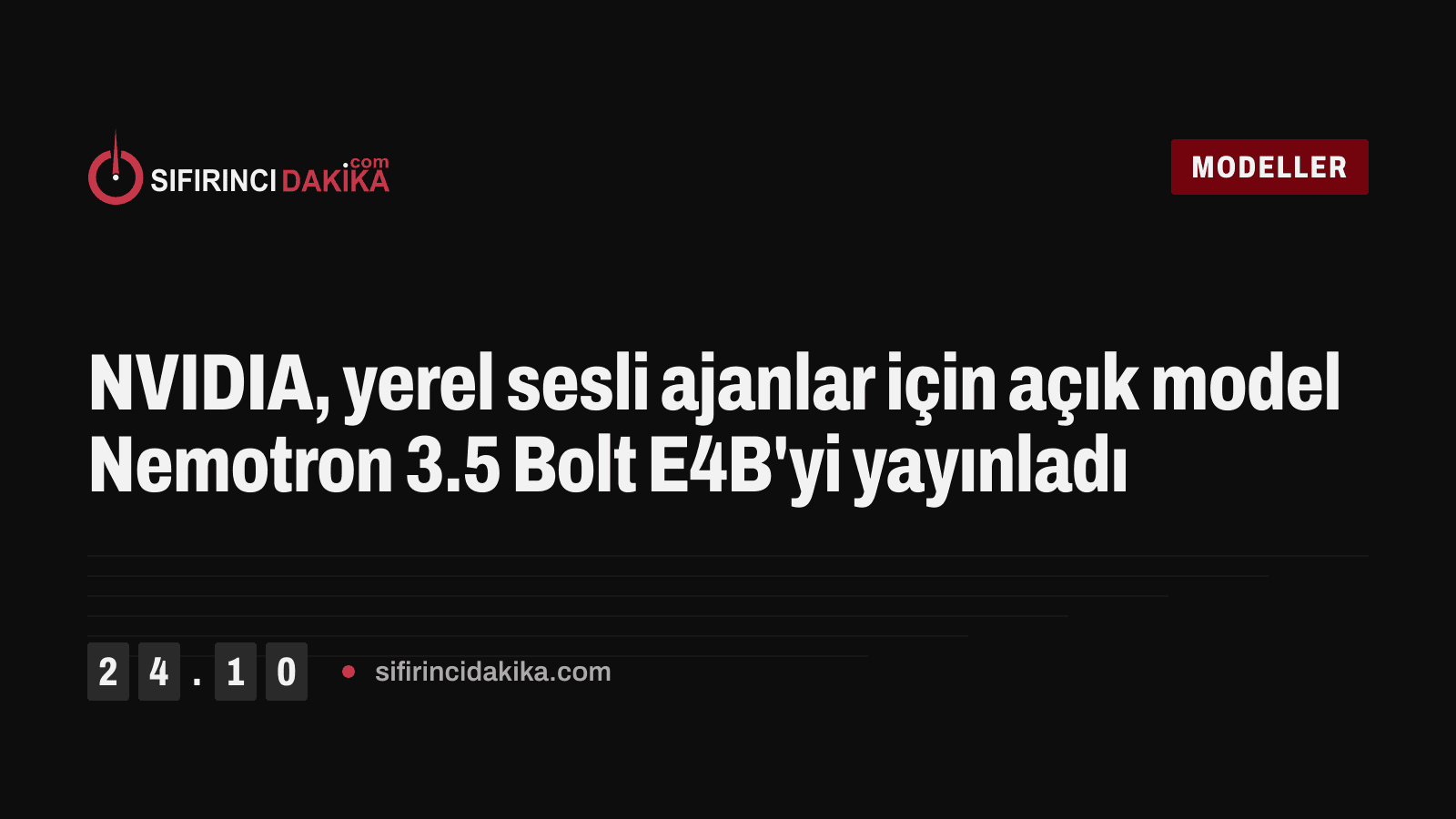
NVIDIA releases Nemotron 3.5 Bolt E4B, an open model for local voice agents

ModelsLaunch1 min read

In brief

NVIDIA announced Nemotron 3.5 Bolt E4B, an open small language model that runs locally on GeForce RTX, Jetson and Spark hardware. Post-trained from Google's Gemma 4 E4B with reinforcement learning only, it targets roughly 4GB of VRAM. NVIDIA says it led 15 of 21 benchmarks against rivals.

  • 8B total / 4B effective parameters, 64K context
  • ~4GB VRAM target (3.1-4.3 GB measured on RTX)
  • RL-only post-training, no SFT stage
  • Multi-turn tool calling and speech-ready reply mode
  • Speculative decoding with DFlash drafter

What was announced?

NVIDIA released Nemotron 3.5 Bolt E4B 4GB, an open small language model built for local conversational agents. It targets on-device use cases such as voice assistants, game characters and robot interfaces, and runs on GeForce RTX, Jetson, RTX Spark and DGX Spark hardware.

Technical overview

The model has 8 billion total and 4 billion effective parameters with a 64K context window. In NVIDIA's RTX tests, the Q4_K_M build used 3.1 to 4.3 GB of VRAM, while the GGUF file is 6.18 GB. The company says the remaining memory leaves room for speech and vision models.

How it was trained

NVIDIA started from Gemma 4 E4B and trained it with reinforcement learning only (RLVR and RLHF), skipping supervised fine-tuning entirely. According to the company, SFT improved tool calling but hurt Gemma's conversational quality and conciseness. The datasets and full recipe are public.

Performance

By NVIDIA's own measurements, the model led 15 of 21 benchmarks against Gemma 4 E4B, Qwen3.5-4B and Nemotron 3 Nano 4B. Its strongest result was 84.8 on IHEval; its weakest was 55.1 on Tau2-Bench, roughly 20 points behind Qwen3.5-4B. With the DFlash drafter, it reached 272.6 tokens per second on an RTX 5070.

Why it matters

The model delivers multi-turn tool calling and short, speech-ready replies in about 4GB of VRAM, opening the door to agents that run without a cloud connection.

Why it matters

A concrete option for readers seeking a memory-friendly open model for local agents and robots, especially notable for its hardware requirements and where it falls short.

Sources

Related stories