Skip to content
Sıfırıncı Dakika
Latest

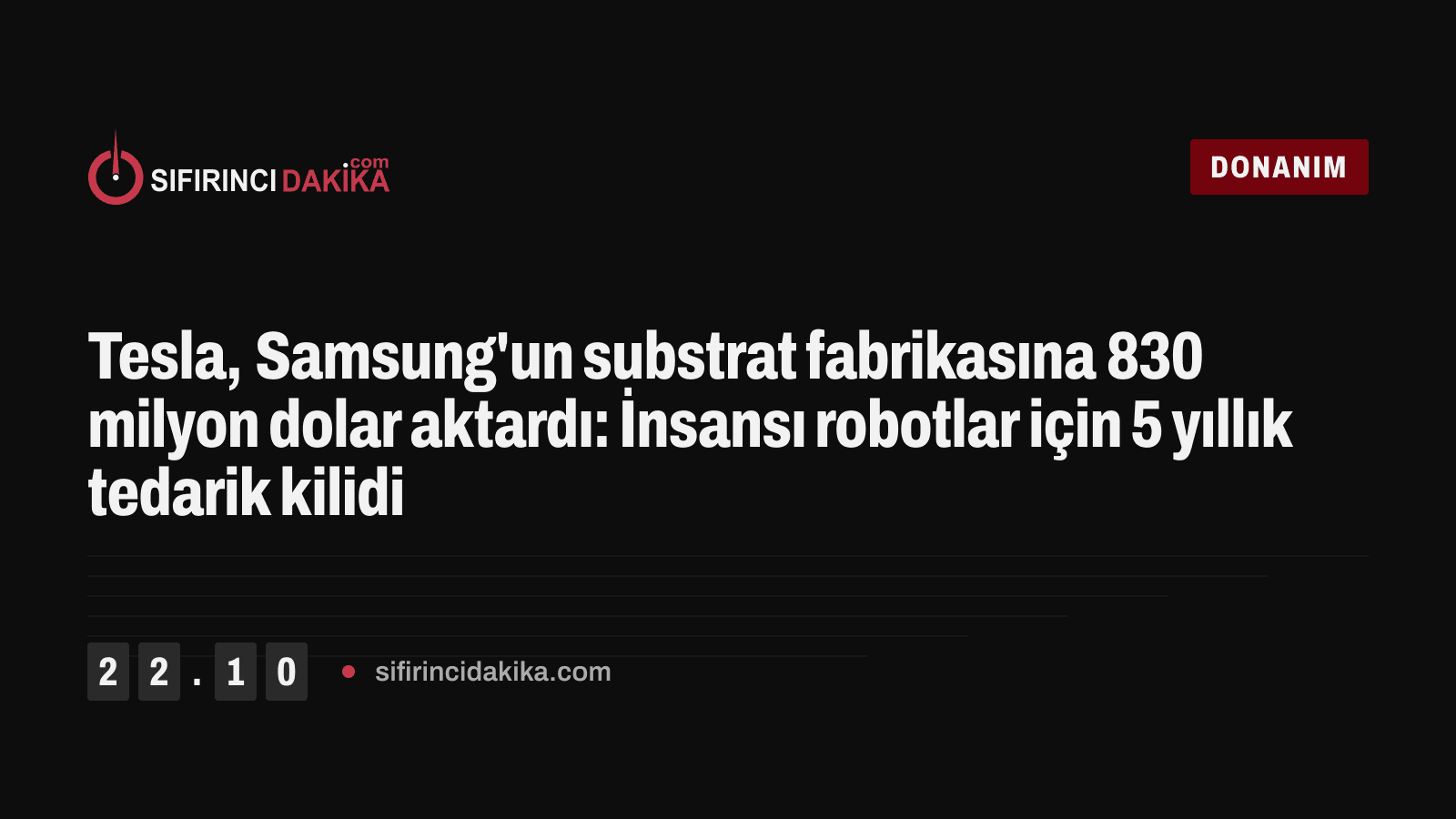
Tesla puts $830 million into Samsung's substrate plant to lock five years of supply for humanoid robots

Hardware1 min read

In brief

Tesla and NVIDIA reportedly paid Samsung nearly $3 billion to develop FC-BGA substrates for AI chips. Tesla's $830 million share is said to secure a five-year supply guarantee for its Optimus humanoid robot and self-driving cars.

  • Tesla and NVIDIA paid roughly $3 billion combined for Samsung's FC-BGA substrate production
  • Tesla's share is $830 million
  • In return, a five-year supply guarantee
  • FC-BGA flips the die and connects it via solder bumps
  • Target: the Optimus humanoid robot and self-driving cars

What happened

According to a report by Maekyung, Tesla and NVIDIA have paid Samsung roughly $3 billion combined to develop substrates for artificial intelligence chips. Tesla's portion is reported at $830 million, in exchange for a five-year supply guarantee.

Why substrates matter

The technology is called Flip Chip-Ball Grid Array (FC-BGA). In simple terms, the die is flipped upside down and connected to the substrate in the package through solder bumps. This delivers significantly better performance than older approaches such as Plastic Ball Grid Array (PBGA).

The two companies reportedly moved early because substrates are expected to become the next bottleneck in the AI supply chain. FC-BGA is a critical component in advanced packaging such as chip-on-wafer-on-substrate (CoWoS).

The Tesla angle

Tesla's investment is aimed at securing uninterrupted access to chips for its Optimus humanoid robot and self-driving vehicles, giving the company a long-term lock on supply.

Why it matters

The AI chip bottleneck is no longer just about fabrication capacity; it is also shifting to packaging and substrate layers. Large buyers putting money directly into these layers signals how supply priority may be allocated going forward.

Why it matters

This shows the AI chip bottleneck shifting from fabrication to packaging and substrates, and how giants like Tesla and NVIDIA are locking down supply with cash — useful for readers tracking the AI hardware supply chain.

Sources

Related stories