How AI factory returns are calculated
NVIDIA says AI factories are built by the megawatt, even by the gigawatt, with each megawatt factory costing roughly $60 million. Operators committing capital at that scale need a clear view of the return. According to the company, three things shape it: what the factory could earn in a year if it sold every token it can produce, how long its hardware keeps earning, and how much demand there is for those tokens.
The three are not fully interchangeable. High earning capacity counts for little if the factory sells only part of what it can produce. High demand matters little if it stops producing at full capacity in just a year.
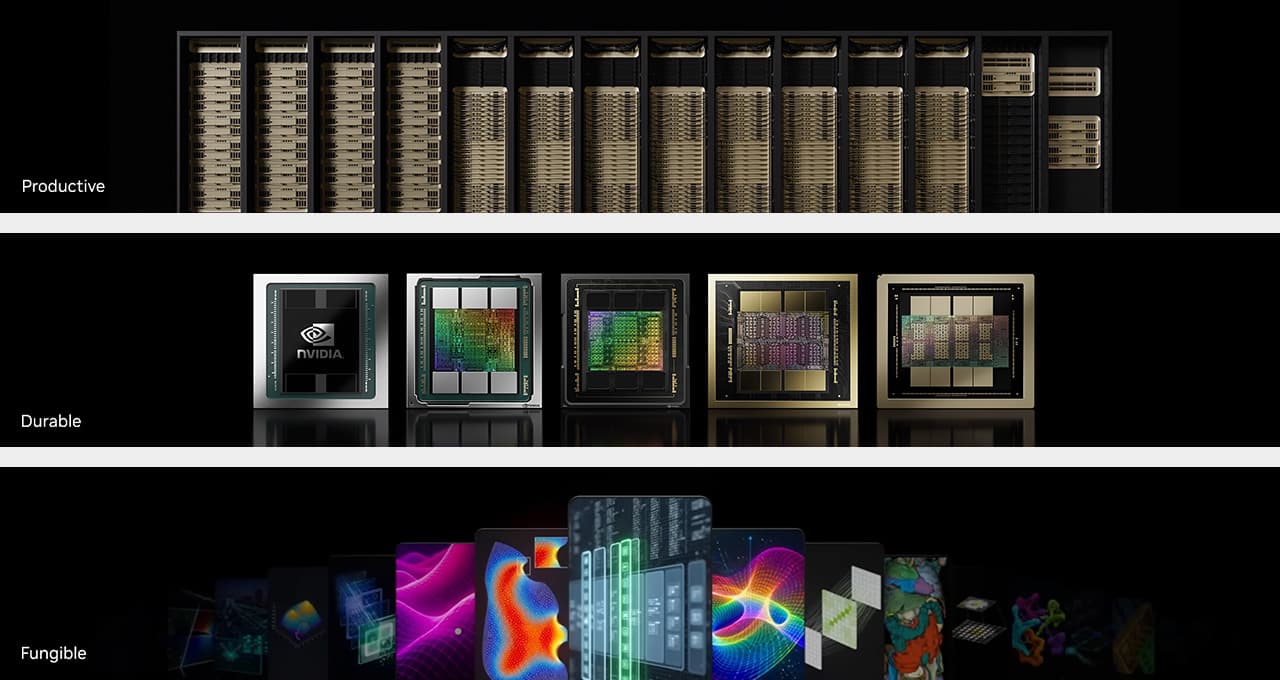
Productive, durable, fungible
NVIDIA says its AI factories are engineered around three principles:
- Productive: Highest throughput per megawatt and lowest cost per token.
- Durable: GPUs and systems keep earning years after they ship.
- Fungible: They run every type of AI, in every phase and every place, plus many workloads that don't involve AI at all.
The company attributes this to engineering codesign across the full stack and continuous software optimization. CUDA-X libraries let a factory run any accelerated workload.
The efficiency claim
Citing SemiAnalysis AgentX data, NVIDIA says Vera Rubin NVL72 systems deliver over 30x higher throughput per megawatt than GB300 NVL72 and up to 45x lower cost per million tokens on the DeepSeek V4 Pro model.
The post addresses two questions: if tokens get dramatically cheaper, does demand for compute shrink, and what happens to older generations? NVIDIA answers the first with "no, it expands," arguing cheaper tokens make more use cases economical. On the second, it notes not every workload needs the newest system, pointing out that the A100 GPU shipped in 2020 and is still in commercial service six years later.
Extending useful life
NVIDIA notes that major operators have extended their server depreciation schedules over the years. Citing a September 2026 Sprout analysis, it says accounting life is a conservative proxy for physical life: Microsoft's NVIDIA V100 fleet ran 8.4 years against a six-year book life.