
An open model for science agents
NVIDIA used SC26 to unveil agent tools for scientific research. Nemotron for Science combines the Nemotron 3.5 Super VL open model with a new open chemistry dataset and post-training recipes for life sciences and chemistry. Researchers can run it locally on a DGX Spark, their own workstation or a supercomputer.
Agents already in use
Ian Buck said an agent at Argonne National Laboratory took a single prompt, planned and tested hypotheses and identified two new binding sites. An agent from KTH Royal Institute of Technology repairs broken GROMACS setups on its own, fixing 81% of test cases in one overnight run on a single DGX Spark. At the SETI Institute, an agent took a one-line prompt to plot a methanol line and then retuned for Doppler shift by itself.
New hardware
Rubin HPC is the Vera Rubin platform's new GPU for science, engineering, analytics and AI. It supports precisions from FP64 to FP4, adds sparse-data acceleration and connects over seventh-generation NVLink. With more than 50,000 CUDA cores, it has about three times as many as Hopper and is expected in 2028. The Vera CPU platform was also expanded for agent loops; Germany's DKRZ climate computing center selected Vera CPUs for its HLRE-5 supercomputer, expected in early 2028.
Quantum collaboration
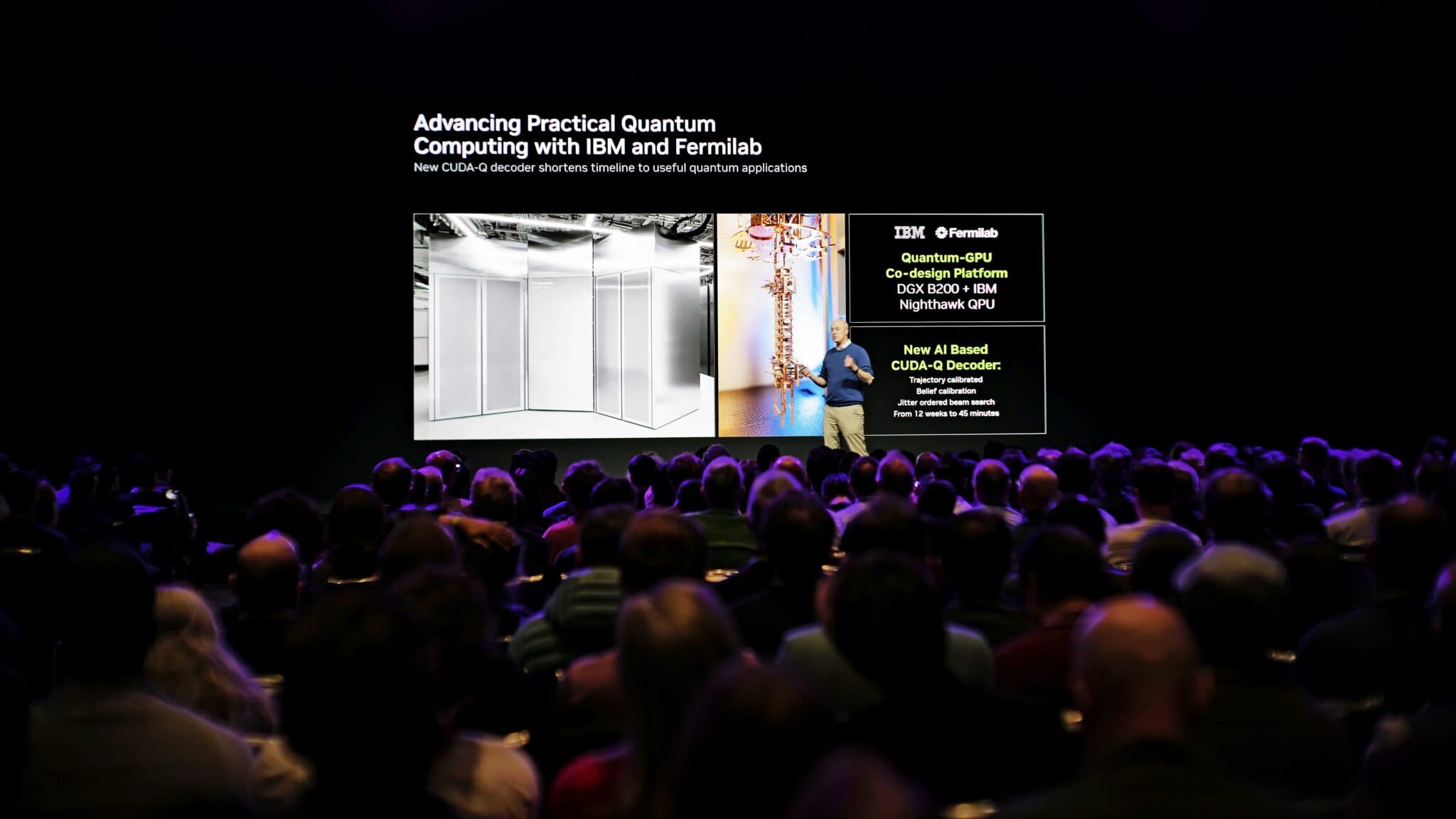
NVIDIA, IBM and Fermilab are teaming up on a quantum computing co-design platform to support error-correction and applications research. NVIDIA DGX B200 systems will be paired with IBM quantum computers, including those powered by IBM Quantum Nighthawk. Buck also said a new CUDA-Q decoding algorithm, TCBP-JOBS, cuts error-correction research computation from 12 weeks to 45 minutes.