
Skip to content
Sıfırıncı Dakika
Latest

NVIDIA, IBM and Fermilab to Launch Quantum-Classical Codesign Platform

Hardware1 min read
NVIDIA Newsroom

In brief

NVIDIA announced a collaboration with IBM and Fermilab on a modular quantum-classical codesign platform aimed at accelerating quantum error-correction research. NVIDIA also released TCBP-JOBS, a new decoding algorithm in its CUDA-Q platform that delivers up to 13,000x speedup, cutting computation time from 12 weeks to 45 minutes.

  • NVIDIA DGX B200 systems colocated with IBM quantum computers
  • Quantum processors powered by IBM Quantum Nighthawk
  • Joint modular quantum codesign platform with IBM, Fermilab and NVIDIA
  • TCBP-JOBS decoding algorithm within CUDA-Q
  • Up to 13,000x speedup in error-correction research
  • Slurm support for scheduling quantum processors

Quantum and classical computing together

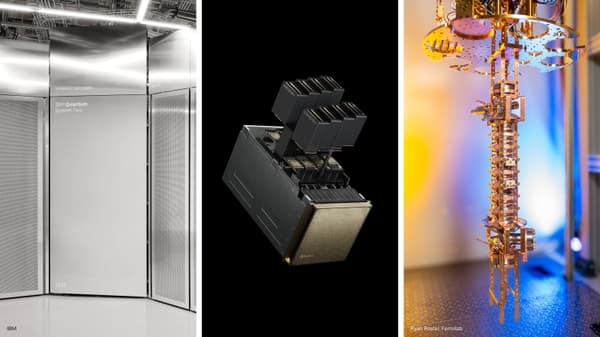
NVIDIA announced new collaborations with IBM and the U.S. Department of Energy's Fermi National Accelerator Laboratory (Fermilab) to advance the scientific use of quantum computers. The effort combines NVIDIA's accelerated computing and software with IBM quantum computers.

IBM and NVIDIA are colocating NVIDIA DGX B200 systems with state-of-the-art IBM quantum computers, including those powered by IBM Quantum Nighthawk, the most powerful quantum processor IBM has built. This integrated system supports a jointly developed modular quantum codesign platform.

Error correction and application research

The platform will let researchers develop and evaluate error-correction codes, decoding algorithms and quantum-classical applications. Fermilab's expertise will focus the work on quantum error correction and high-energy and nuclear physics (HENP) applications, helping define requirements for future fault-tolerant quantum computers.


Up to 13,000x speedup

NVIDIA also released TCBP-JOBS, a new decoding algorithm that is part of its CUDA-Q platform. According to the company, it delivers up to 13,000x faster decoding than existing leading algorithms, cutting the computation time for researching new quantum designs from 12 weeks to just 45 minutes.

Slurm integration

As part of the collaboration, NVIDIA is expanding Slurm to simplify scheduling quantum processors within supercomputing workflows. IBM is contributing integration through its Quantum Resource Management Interface.

Why it matters

Practical quantum computing depends on faster error-correction research, and this announcement shows a concrete step in that race.

Sources

Related stories